
Domain Transfer
Definition
Transfer of learning, sometimes called domain transfer, concerns the ability of a learner to apply knowledge, skills and attitudes acquired in one context and apply it in another.
Transfer is a critical pillar of chess in education (CIE) theory and, more generally, in education psychology. A core argument for the broad use of chess in the classroom is that the skills learned in chess are transferable to academic and social-emotional domains.
Types of domain transfer include:
- Near transfer: the transfer of knowledge to a similar domain (e.g., algebra to calculus).
- Far transfer: the transfer of knowledge to a dissimilar domain: e.g., chess to mathematics or science.
It is also important to understand the ease or difficulty associated with learning transfer.
Achieving far transfer—the application of skills from a specific domain like chess to a seemingly unrelated domain such as academic performance or social-emotional regulation—is not an automatic process. It requires a deliberate shift from viewing chess as a game to treating it as a pedagogical laboratory.
CIE theorists and practitioners increasingly stress the importance of high-road transfer in developing effective CIE curricula and methodologies.
How Chess is Taught Makes a Difference
CIE advocates recognize the need for teaching methodologies that intentionally encourage a transfer of skills. This is backed up by pedagogical research over the past two decades. While near and far transfer remain part of the foundation of pedagogical theory, research by scholars like Bransford, Schwartz, and Lobato—has shifted from seeing transfer as a “cut and paste” transport of some bit of knowledge across domains to seeing it as a preparation for future learning (PFL) process.
Current pedagogy focuses less on “brain training” and more on high-road transfer techniques involving “bridging” or “boundary crossing”. These techniques consciously translate skills from one community of practice (chess class) to another (the academic classroom or workplace). These techniques can be found in chess training offered by the European Chess Union, FIDE, Chess in Education – US, and other CIE leaders.
An Example
The EduEscacs program implemented in the FEDAC schools of Catalonia using the TRACIS methodology, developed by Ramon Pérez Rodríguez, offers an instructive example of this theory in action.
The TRACIS curriculum explicitly promotes reflection, self-regulation, and metacognitive awareness to achieve far transfer. Its methodology conceptualizes chess as an educational instrument involving six interrelated dimensions:
- T – Tactics, as a language of thought
- R – Reflection, to analyze and justify decisions
- A – Analysis and Experimentation, where error becomes learning
- C – Communication, to verbalize thinking
- I – Interaction, as a social construction of knowledge
- S – Systematization, to consolidate and transfer learning
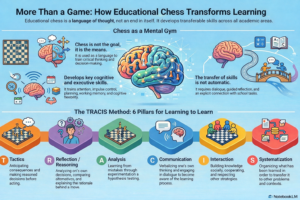
For additional details, see Educational Chess: From Curricular Practice to Cognitive Transformation.
Further Reading
Gobet, F. (2019). The Psychology of Chess.
Otterbach, R. (2018). Chess and the Concept of Learning Transfer
Rodríguez, R. (2026). Educational Chess as a Language of Thought and Learning Transfer.
Sala, G.and Gobet, F. (2016) Do the Benefits of Chess Instruction Transfer to academic and cognitive skills? A meta-analysis. Education Research Review, 46-57