
Mindset Theory
Definition
Formulated by Stanford psychologist Carol Dweck, mindset theory holds that people tend to have one of two different mindsets about their abilities and potential:
- A fixed mindset tends to view abilities and intelligence as static traits. Such people may avoid challenges to prevent failure and may feel driven to constantly prove their intelligence.
- A growth mindset presumes that abilities can be developed through effort, learning, and persistence. A person with a growth mindset sees challenges as opportunities to grow, views effort as the path to mastery, and acts resilient in the face of setbacks. A person with a growth mindset is likely to believe, “I can improve my chess skills with practice” or “I can improve my teaching skills over time.” This approach fosters resilience, motivation, and a willingness to embrace continuous learning.
A fixed mindset may be fine for low challenge activities, for example, riding a bicycle. For high challenge activities, a growth mindset is key to making long-term performance gains.
The CIE Connection: The Talent Trap
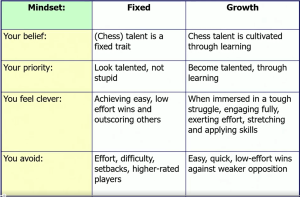 In the world of chess, a fixed mindset is a pervasive danger.
Because chess is culturally associated with “high intelligence,” we often fall into the trap of labeling young players as “gifted” or “naturals.”
As Barry Hymer and Peter Wells highlighted in their 2025 “Mindset and Mastery” presentation at the Mindsets Chess Conference, the most “able” students are often the ones most at risk. These students often love performing (winning) more than they love learning. When a “talented” child encounters their first major plateau or defeat, their fixed mindset tells them they have reached the limit of their innate gift. Without a growth-oriented framework, these students are the most likely to quit the game when it becomes difficult.
Our goal as educators is to shift the focus from performance to mastery. If a student is passionate about the process of learning, the performance—the ratings and trophies, grades and career success—eventually takes care of itself.
How to Teach Growth Mindsets in Chess Class
Find practical strategies for teaching a growth mindset visit The Power of Growth Mindset When Teaching Chess.