

Mindset Theory
Mindset theory has become a cornerstone of discussion about education and personal development. Carol Dweck, a psychologist at Stanford University, introduced the growth vs. fixed mindset framework in the 1970s–1980s. The theory holds that people tend to have one of two different mindsets about their abilities and potential:
- A fixed mindset tends to view abilities and intelligence as static traits. Such people may avoid challenges to prevent failure and may feel driven to constantly prove their intelligence.
- A growth mindset presumes that abilities can be developed through effort, learning, and persistence. A person with a growth mindset sees challenges as opportunities to grow, views effort as the path to mastery, and acts resilient in the face of setbacks. A person with a growth mindset is likely to believe, “I can improve my chess skills with practice” or “I can improve my teaching skills over time.” This approach fosters resilience, motivation, and a willingness to embrace continuous learning.
Mindsets in Chess Class
Chess teachers and coaches can play a crucial role in shaping the mindsets of their students, not just with respect to chess, but for any high challenge activity. Chess is a crucible that brings out all of the anxieties of learning that are at the heart of mindset theory. Therefore, it is important for instructors to both understand mindset theory and spot it in their students’ behavior.
Researchers have recognized the importance of a growth mindset to chess in education. Psychologist and author Barry Hymer presented this chart at the 2025 Mindsets: Chess in Education Conference in a presentation titled “Chess Improvement: It’s All in the Mindset.”
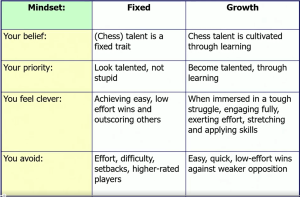
Educational chess stresses the importance of a growth mindset.
It is over-simplistic to say that a growth mindset is always “good” and a fixed mindset is bad. A fixed mindset may be fine in low challenge situations where there is no need to maintain a growth mindset. Maintaining a growth mindset does require focus and some mental energy. When it comes to tying one’s shoes, a fixed mindset works just fine. In chess and other high-challenge disciplines, a growth mindset is key and worth the effort.
The “Talent Trap” in Chess Education
In the world of chess, a fixed mindset is a pervasive danger. Because chess is culturally associated with “high intelligence,” we often fall into the trap of labeling young players as “gifted” or “naturals.”
As Barry Hymer and Peter Wells highlighted in their recent “Mindset and Mastery” presentation, the most “able” students are often the ones most at risk. These students often love performing (winning) more than they love learning. When a “talented” child encounters their first major plateau or defeat, their fixed mindset tells them they have reached the limit of their innate gift. Without a growth-oriented framework, these students are the most likely to quit the game when it becomes difficult.
Our goal as educators is to shift the focus from performance to mastery. If a student is passionate about the process of learning, the performance—the ratings and trophies, grades and career success—eventually takes care of itself.
Practical Strategies for the Classroom
How do we move from theory to practice? For a chess program to survive and thrive within a school curriculum, it must be built on a foundation of growth:
- Process-Oriented Praise: Stop praising “smart moves” or “talent.” Instead, praise the process. “I love how you stayed focused even when you were down a pawn,” or “That was a great use of the tactical pattern we studied last week.” This reinforces that success comes from strategy and effort, not magic.
- High-Stakes Learning, Low-Stakes Outcomes: Create an environment where the challenge is high but the fear of failure is low. As Hymer suggests, for a growth mindset to be useful, the challenge must be significant. If a task is too easy, there is no need to grow. We should encourage students to seek out opponents who are better than them, reframing a loss as the “best lesson of the day.”
- Metacognitive Journaling: Encourage students to write down their thoughts during or after a game. Why did they choose a certain plan? What were they feeling during a time scramble? This turns a game of chess into a document of their mental growth.
- Building a Social Domain: In the realm of competitive chess, Sunil Weeramantry and Michael Khodarkovsky emphasized that “institutionalizing” chess requires moving beyond the “one-man show.” We must build a community (an esprit de corps) where students support each other’s growth. A team that analyzes together and values collective improvement over individual trophies is a team with a growth mindset.
Conclusion
The value of chess in education is not found in the checkmate; it is found in the struggle to find the checkmate. By embracing Carol Dweck’s mindset theory, we can transform our chess clubs and classrooms into laboratories for character development.
When we teach children that their brains are like muscles that grow stronger with every difficult puzzle solved and every loss analyzed, we give them a gift that lasts far longer than a chess tournament. We give them the mindset of a master—not just of the board, but of their own potential.
 Author: Neil Dietsch, Managing Director, Chess in Education – US
After earning an MBA at the University of Michigan, Neil Dietsch’s professional career included information technology consulting, management, and senior project management positions in dozens of Fortune 500 companies. He served as president of the Alabama Chess Federation from 2010 to 2019. In 2016 he co-founded, with Jerry Nash, the educational charity Chess in Schools – which became Chess in Education – US in 2023.