
Author
 Ramon Pérez Rodríguez is an educator and educational chess specialist focused on the development of thinking skills, executive functions, and learning transfer in school contexts. He is the creator of the TRACIS methodology, a pedagogical framework that understands chess not as an end in itself, but as a language of thought used to promote reflection, self-regulation, and metacognitive awareness.
His work centers on making students’ thinking visible through dialogue, guided questioning, and structured analysis, with particular attention to learners with academic or cognitive difficulties.
Playing Chess Where Talking is Not Forbidden
Chess has traditionally been associated with silence, competition, and technical mastery. However, the greatest educational potential of chess lies not in memorizing openings or winning games, but in its capacity to function as a language of thought. This article presents a pedagogical perspective on educational chess based on intentionality, dialogue, and metacognitive reflection. Drawing on classroom experience and the TRACIS methodology, chess is described as a powerful tool for fostering executive functions, learning transfer, and the competence of learning to learn. When chess is accompanied by guided reflection and communication, it becomes a meaningful context for developing cognitive, linguistic, and self-regulatory skills.
Chess Beyond the Game: A Cognitive Perspective
Chess is often introduced in schools as an extracurricular activity or as an enrichment tool focused on logic and strategy. Yet, when observed closely, chess reveals itself as much more than a game: it is a structured environment for thinking. Each position presents a problem that requires interpretation, anticipation, comparison of alternatives, and decision-making under constraints. These processes closely resemble those involved in reading comprehension, mathematical problem solving, and everyday decision-making.
In educational contexts, many students—especially those with learning difficulties—demonstrate at the chessboard cognitive strengths that are not always evident in traditional classroom tasks. Concentration, perseverance, impulse control, and analytical thinking often emerge naturally during play. This observation raises a central question: how can this way of thinking be transferred from chess to school learning and to life?
The answer is clear: transfer is not automatic. Playing chess alone is not enough. Educational value arises only when students are taught to reflect on what they do, why they do it, and how they can apply those strategies elsewhere.
Pedagogical Intentionality and High-Road Transfer
The first pillar of educational chess is understanding chess not as an end, but as a means. Each chess position becomes a problem to be read and understood before acting. Students are encouraged to describe the situation, identify relevant information, anticipate consequences, and justify their choices. This deliberate pause before action reduces impulsivity and cognitive blocks, particularly in students who struggle academically.
While traditional play rarely yields automatic results, this structured process enables high-road transfer to reading and mathematics. High-road transfer occurs when a student mindfully abstracts a rule or strategy from one context and “bridges” it to another.
Understanding a chess position parallels understanding a text: both require identifying key elements, establishing relationships, and constructing meaning. Similarly, solving a chess problem mirrors the steps involved in mathematical problem solving. When students learn to verbalize their thinking at the chessboard, they are better prepared to do so in both in the academic classroom and the workplace.
To achieve genuine transfer, TRACIS employs a ‘Bridging’ phase. For example, after analyzing a ‘discovered attack’ (where one piece moves to reveal another’s influence), the teacher explicitly asks: ‘Where else in life do we reveal a hidden idea by removing something visible?’ or ‘How is this like finding the implicit main idea in a paragraph?’ This explicit abstraction is essential for the skill to leave the chessboard.
Crucially, this transfer only occurs when sessions are guided by a clear pedagogical question: What do we want students to learn to think about today? Attention, planning, cognitive flexibility, and inhibition must be addressed explicitly through carefully designed questions and prompts.
Metacognition: Thinking About Thinking
A central contribution of educational chess lies in its capacity to foster metacognition. The most important learning moment does not occur when a move is played, but afterwards, when students are invited to reflect: Why did I choose this move? What did I consider? Is there something I missed? What should I do differently next time?
This reflective dialogue transforms chess into a tool for developing the competence of learning to learn. Students become aware of their own strategies, strengths, and limitations. Over time, they learn to plan, monitor, and evaluate their actions—skills that are essential for autonomous learning across disciplines.
Dialogue and Language as Cognitive Tools
Contrary to the traditional image of chess as a silent activity, educational chess strongly benefits from talking. Explaining moves, listening to others’ reasoning, and debating alternatives strengthen both language development and cognitive structuring. The chessboard serves as a visual and concrete support that facilitates oral expression and comprehension, particularly for students with linguistic or learning difficulties. The emphasis on dialogue aligns with Vygotsky’s concept of inner speech. By verbalizing their analysis (‘I think the bishop is dangerous because…’), students are essentially practicing the transition from social speech to inner regulatory thought, which is the core of executive function development.
Through dialogue, thinking becomes visible. Students do not merely play; they construct meaning collectively, negotiate interpretations, and refine their reasoning. In this sense, chess becomes a social and communicative activity that supports deeper understanding.
Emotional Safety and Self-Regulation
Another essential condition for meaningful learning is the creation of an emotionally safe environment. In educational chess, errors are not penalized but analyzed. Frustration is acknowledged and verbalized, and effort is valued above results. This approach fosters perseverance, confidence, and emotional regulation.
Such conditions are indispensable for far transfer, including self-regulation, critical thinking, and responsible decision-making. When students feel safe to make mistakes and reflect on them, learning becomes sustainable and transferable.
The TRACIS Method: A Structured Framework
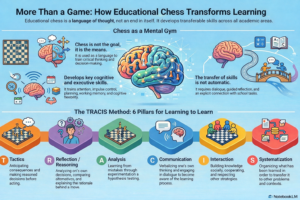
The TRACIS methodology integrates these principles, which conceptualizes chess as an educational instrument through six interrelated dimensions:
- T – Tactics, as a language of thought
- R – Reflection, to analyze and justify decisions
- A – Analysis and Experimentation, where error becomes learning
- C – Communication, to verbalize thinking
- I – Interaction, as social construction of knowledge
- S – Systematization, to consolidate and transfer learning
TRACIS aligns with theoretical contributions to self-regulated learning and metacognition, emphasizing that cognitive development requires structure, continuity, and guided reflection. There are no universal recipes: the same task can serve different objectives depending on age, level, and intent. What matters is the quality of the questions and the educational guidance.
Many educational activities today are labeled as competency-based, yet they often fail to make thinking visible or to promote genuine self-regulation. Well-designed educational chess offers a privileged context to address these shortcomings. It obliges students to stop, anticipate, review, and explain—core processes of meaningful learning.
Ultimately, playing chess where talking is not forbidden is not about teaching chess. It is about educating the mind. When chess is accompanied by intentional reflection and dialogue, it does not merely teach students how to play better games—it teaches them how to think, learn, and decide.
Systematization as the Bridge to Mathematics
Crucially, the ‘S’ for Systematization represents the exact moment where transfer is engineered. It is not enough for a student to calculate a checkmate in three moves; they must encode how they did it. For instance, when a student solves a problem by imagining the final position (checkmate) and working backwards to the current move, the educator intervenes to systematize this as ‘Retrograde Analysis.’
In the Systematization phase, the teacher explicitly disconnects this strategy from the chess pieces and presents a multi-step mathematical problem. The question shifts from ‘What is the best move?’ to ‘How can we apply Retrograde Analysis to solve this equation?’ By naming the cognitive strategy (working backwards) and applying it to a different domain, the student stops seeing chess and math as separate worlds and begins to see them as contexts requiring the same mental toolkit. Without this explicit systematization, the skill remains trapped on the chessboard.
TRACIS in Action
Scenario: A student (Marc) quickly reaches for his Bishop to capture an opponent’s pawn, failing to notice that this move will leave his King unprotected (a mistake driven by impulsivity).
| Phase / Dimension | Traditional Approach (Competitive) | TRACIS Approach (Educational) | Cognitive Goal Achieved |
| Initial Intervention | “No, Marc! Don’t do that! You’ll lose the piece!”
(Teacher corrects the action immediately) |
“Hands under the table, Marc. Before touching the piece, explain to me what you are looking at.”
(Teacher halts the impulse) |
Inhibitory Control (Executive Function) |
| Error Analysis | “If you take the pawn, the Rook takes you. It’s a bad move.”
(Teacher provides the solution) |
“If you capture the pawn (Hypothesis A), what do you think your opponent’s best response will be? Check all lines.”
(Teacher guides the exploration) |
Cognitive Flexibility & Planning |
| Communication (C) | (Silence or a quick technical explanation) | “Marc, verbalize the sequence: ‘If I do this, he will do that…’ I want to hear your reasoning aloud.”
(Student must articulate thought into language) |
Structuring Inner Speech |
| Systematization (S) (Transfer) | “Pay more attention next time.”
(Generic advice) |
“What you just did (stopping, reviewing consequences, then deciding) is called Double-Checking. Did you use this strategy in yesterday’s math test before handing it in?”
(Explicit connection to real life) |
Metacognition & High-Road Transfer |
Conclusion
The TRACIS methodology reimagines educational chess as a “language of thought” rather than a mere competitive game. By prioritizing intentional dialogue and metacognitive reflection over technical mastery, this framework creates a structured environment where students can develop essential executive functions such as inhibitory control, planning, and cognitive flexibility. Crucially, the methodology emphasizes that the transfer of these skills to
academic domains—like mathematics or reading comprehension—is not automatic; it requires explicit pedagogical guidance to bridge the gap between the chessboard and real-life applications. Ultimately, “playing chess where talking is not forbidden” serves as a social and communicative tool that empowers learners to make their thinking visible, turning every move and error into an opportunity for sustainable, self-regulated learning.