
Author: Ramon Pérez Rodríguez is an educator and educational chess specialist focused on the development of thinking skills, executive functions, and learning transfer in school contexts. He is the creator of the TRACIS methodology, a pedagogical framework that understands chess not as an end in itself, but as a language of thought used to promote reflection, self-regulation, and metacognitive awareness. His work centers on making students’ thinking visible through dialogue, guided questioning, and structured analysis, with particular attention to learners with academic or cognitive difficulties.
Published: July 8, 2026
What Does it Take to Teach Chess in a Primary School Classroom?
For more than ten years, I have been bringing chess into primary school classrooms as part of the regular curriculum. During that time, I have come to realize that the real challenge has never been the chessboard itself—it is confidence.
Whenever I speak with fellow teachers about introducing chess into their classrooms, I almost always hear the same response: “I don’t know enough about chess.” The obstacle is rarely a lack of teaching materials or curriculum guidelines. Instead, it is an emotional barrier. As teacher educators, I believe we often make the mistake of trying to reduce this insecurity by providing even more technical knowledge—openings, notation, complex variations—when what teachers actually need is something much smaller, more practical, and far more empowering.
Over the years, I have reached a simple conclusion: we do not need expert chess players in our schools. We need teachers who can help children think. Fortunately, this requires much less chess knowledge than most people imagine.
Essential Skills
Through years of trial, reflection, and classroom experience, I have identified a small set of skills that are truly essential for any teacher who wishes to use chess as an educational tool. Teachers do not need to compete at a high level. They simply need to be comfortable playing a game with sound judgement, avoiding obvious mistakes and encouraging thoughtful decision-making.
It is enough to recognize the tactical patterns that appear repeatedly in beginner games: forks, pins, discovered attacks, and simple checkmate patterns such as the back-rank mate. Knowing the basic mating procedures with a king and queen or a king and rook is more than sufficient.
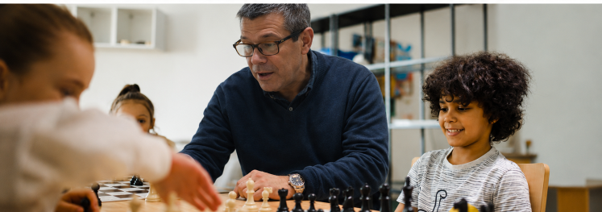
>Above all, however, teachers need something that is much harder than playing well themselves: they need to ask good questions instead of giving ready-made answers.
Rather than saying, “Move the bishop,”; they might ask, “Which of your pieces is not contributing to the position?” Instead of correcting every mistake immediately, they can transform errors into opportunities for reflection. They can help children cope with the frustration of losing, the excitement of winning, and, perhaps most importantly, notice how much they have improved
since the previous week. In my experience, that is enough to create meaningful learning through chess.
This way of understanding chess education is closely connected to ideas that are already well established in chess education pedagogy and research. Effective teaching does not require knowing everything; it requires understanding a subject deeply enough to guide someone else in constructing that knowledge. Children do not learn simply because they play a game. They learn because an adult is beside them, asking questions that encourage them to reflect on their own thinking.
Professional Development for Teachers
With this philosophy in mind, I designed a very short professional development program for teachers: six hours divided into three two-hour sessions. There are no lectures, no lengthy theoretical explanations, and no expectation that participants will become strong chess players. Instead, teachers learn by playing, just as their pupils will later learn in the classroom. They experience uncertainty, hesitation, and the challenge of making decisions under pressure. By living through these emotions themselves, they begin to understand why patient guidance is more valuable than technical instruction.
- The first session has one clear objective: helping teachers overcome their fear of the chessboard. Participants become familiar with the pieces, experiment with simple positions, and discover that making mistakes is not only acceptable but an essential part of learning.
- The second session shifts the focus from playing to thinking. Rather than searching for the “best move,” teachers learn to ask questions that stimulate reflection: What is your opponent threatening? Which of your pieces is least active? What would happen if you waited one move before acting? These questions encourage children to analyze situations instead of relying on
intuition alone. - The third session bridges theory and classroom practice. Teachers design a real lesson for their own pupils, adapting activities to the age, interests, and needs of their class. The emphasis is not on teaching chess content, but on creating learning experiences that strengthen planning, self-control, flexible thinking, and thoughtful decision-making.
Stages of Teacher Development
Over time, I have come to imagine teacher development as a staircase with four steps.

- The first is simply learning alongside one’s pupils.
- The second is becoming capable of helping them think—a level that, in my opinion, is already sufficient for teaching chess successfully in primary education.
- The third involves designing original activities and adapting them creatively to different groups of learners.
- Finally, the fourth consists of mentoring other teachers and helping them begin the same journey. Importantly, reaching the top is not necessary. Excellent classroom practice can already emerge from the second step.
Setting Expectations for an Educational Chess Program
Research has also reinforced another conviction of mine. Playing large numbers of chess games does not automatically improve mathematics, reading comprehension, or other academic skills. Any transfer of learning depends on guided reflection. Children need support in recognizing how they think while they play and in connecting those thinking processes with challenges they encounter beyond the chessboard. Without this metacognitive dimension, chess remains simply another enjoyable game.
For this reason, I prefer not to make exaggerated claims. I do not argue that chess makes children more intelligent. Rather, I believe it provides them with regular opportunities to practice calm decision-making, sustained attention, planning, emotional regulation, and thoughtful reflection. Those capacities, developed week after week, are educationally valuable in their own right.
Another lesson I have learned over the years is that chess programs rarely disappear because children lose interest. More often, they disappear because they depend entirely on one enthusiastic teacher. When that teacher changes schools or takes on a different role, the project often disappears with them.
For this reason, I believe chess education should never rely on individual commitment alone. It needs to become part of the school’s educational culture. School leaders must recognize its value and allocate time for it within the curriculum. Teachers should have opportunities to learn together, observe one another’s lessons, and reflect collectively on their classroom practice. Families should also be invited to participate, not because they need to become chess players themselves, but because they can reinforce the attitudes that children develop through the game: patience, perseverance, thoughtful decision-making, and respect for others.
I have witnessed schools where, at the beginning, almost nobody felt confident enough to teach chess. A year later, however, chess had become a natural part of everyday school life. The most rewarding change was not hearing teachers say, “Our pupils play better chess.” It was hearing them say, “Our pupils think more carefully before making decisions.” That, in my opinion, is the true educational value of chess.
Conclusion
 Throughout this journey, two practical tools have become central to my work. The first is the six-hour teacher training program that I have refined over the years. It includes detailed activities that teachers can immediately transfer to their own classrooms. The second is an observation framework that allows teachers to monitor the gradual development of executive functions such as planning, working memory, inhibitory control, cognitive flexibility, and emotional self-regulation. Its purpose is not to grade pupils, but to better understand how each child thinks and learns.
Ultimately, I believe that the greatest barrier to expanding chess in schools is not the shortage of expert chess players. It is the lack of confidence among ordinary classroom teachers—the professionals who work with children every day and already possess the pedagogical skills that matter most. Rather than trying to turn teachers into chess coaches, we should help them become mediators of thinking.
Chess is not an educational miracle, nor is it a shortcut to higher academic achievement. Its value lies elsewhere. When guided by thoughtful teaching, it becomes a powerful context in which children learn to pause before acting, analyze alternatives, regulate their emotions, and justify their decisions. These are not only chess skills; they are life skills.
If we truly want chess to become part of mainstream education, our priority should not be producing stronger players. It should be empowering more teachers to feel capable of using chess as a meaningful educational resource. In doing so, we may discover that the most important move on the chessboard is not made by a child, but by a teacher who asks the right question at the right moment.